
Maintaining healthy grass begins below the surface, where soil chemistry plays a critical role in how your lawn grows, responds to fertilizer, and withstands environmental stress. One of the most important and yet often overlooked factors is soil pH. Many lawns throughout Central New Jersey and Eastern Pennsylvania naturally trend acidic due to rainfall patterns, soil composition, and long-term nutrient cycling. When pH falls outside the ideal range (6.3-6.5), grass may struggle even when properly watered and fertilized. Understanding what soil pH is, how lime is a critical tool for correcting it, and why it matters can help homeowners make informed decisions that lead to stronger, greener, more resilient lawns.
What is Soil pH?
Soil pH is a measurement of how acidic or alkaline the soil is. It is expressed on a logarithmic scale from 0.0 to 14.0, based on hydrogen ion concentration.
- 7.0 = Neutral
- Below 7.0 = Acidic
- Above 7.0 = Alkaline
Each whole number change represents a tenfold difference in acidity. For example, soil with a pH of 5.0 is ten times more acidic than soil with a pH of 6.0.
Most cool season turfgrasses grown in our area prefer slightly acidic soil conditions (pH of 6.3-6.5). When pH moves too far outside the ideal range, grass health and appearance decline even if fertilizer is applied regularly.
What Causes Soil to Become Acidic?
Soil in the Northeastern United States tends to be naturally acidic for several reasons.
1. High Rainfall
Frequent rainfall leaches alkaline elements, such as calcium, potassium, and magnesium, deeper into the soil profile. Over time, this leaves the upper root zone more acidic.
2. Organic Matter Decomposition
Leaves, pine needles, and other plant debris can contribute to acidity as they break down. Areas beneath dense tree canopies often show lower pH levels for this reason.
3. Plant Uptake and Competition
Growing plants absorb alkaline nutrients from the soil. Where grass and tree roots compete, soil acidity can increase more rapidly.
4. Clipping Removal
Regularly removing grass clippings eliminates nutrients that would otherwise recycle back into the soil as they decompose.
Why Soil pH Matters for Grass Plant Health
Nutrient Availability and pH
Soil pH strongly influences whether essential nutrients in your soil are available for grass plants to uptake. Even when nutrients are present in the soil, improper pH can lock them into chemical forms that roots cannot absorb.
Key soil nutrients affected by pH include:
- Nitrogen (N)
- Phosphorus (P)
- Potassium (K)
- Calcium (Ca)
- Magnesium (Mg)
This chart, in general, represents plant nutrient availability based on soil pH levels. The narrow areas of each band represent low availability of each nutrient, while the taller areas represent optimal nutrient availability.
The chart clearly shows that between a pH of 6.0-7.0, availability is at its peak for the most critical lawn nutrients. Notice that at a pH of 5.5, nutrient availability becomes problematic and continues to worsen as soil becomes more acidic. Additionally, as the soil becomes more alkaline than 7.0, nutrient availability suffers as well. However, soil with a pH of 7.0 or higher is very rare in the northeast. Our concern is almost always to keep lawn soil as alkaline as possible. The chart is not specific to just our grass types either. Our cool season grasses prefer an optional pH between 6.3 and 6.5.
One of the most common elements impacted by acidic soil and improper pH is phosphorus. In acidic soils it becomes tightly bound to other minerals and unavailable to plants. This often results in poor grass growth despite proper fertilization.
Toxic Element Solubility
Low pH can also increase the solubility of potentially harmful elements, especially aluminum and manganese.
When these elements become soluble:
- Root growth can be inhibited
- Nutrient uptake is reduced
- Turf may appear thin or stressed
- Overall plant vigor declines
Correcting soil acidity with lime helps reduce these toxic effects while improving growing conditions.
Microbial Activity and Thatch Breakdown
In addition to increased soil nutrient availability at the ideal range, this is also the range at which microorganism activity starts to peak. On the above chart the line labeled actinomycetes illustrates this point. Actinomycetes are bacteria in the soil responsible for the breakdown of a lot of organic matter as well as complex soil nutrients.
Beneficial microbes:



- Decompose organic matter
- Convert fertilizers into plant-available forms
- Help reduce thatch buildup
- Improve overall soil structure
Microbial activity generally peaks in the same ideal pH range preferred by cool season turfgrasses.
How Can Soil pH be Corrected?
Lime is a soil amendment used to increase the pH of acidic soils. Agricultural lime is typically produced by finely grinding natural limestone, which is composed primarily of calcium carbonate.
Lime’s Role in Raising Soil pH
Lime is specifically used to raise soil pH. It neutralizes acidity by reacting with hydrogen ions in the soil solution. As acidity is neutralized, the pH rises toward a more neutral level.
This chemical reaction occurs gradually. Unlike fertilizers that show visible results quickly, lime improves soil conditions over time by changing the environment in which roots grow.
The optimal pH Range to Aim for with Lime
Most turfgrasses and agricultural crops perform best in a slightly acidic to neutral range. However, for cool-season grass types in the lawns we treat, such as Kentucky bluegrass, perennial ryegrass and fine fescue, the optimal range is tighter.
Ideal turf pH for you to aim for is: 6.3 to 6.5
Within this range:
- Nutrient availability is at or near peak levels
- Soil microbial activity is strong
- Root development is optimal
- Fertilizer efficiency improves
Types of Lime and Their pH Impact
The most common liming materials are calcitic or dolomitic agricultural limestone. These are natural products made by finely grinding natural limestone. Since natural limestone is relatively water insoluble, agricultural limestone must be very finely ground so that it can mix with the soil particles and react with other nutrients to change soil acidity. Both calcitic, and dolomitic lime contain calcium carbonate. Dolomitic lime however, also contains magnesium in the form of magnesium carbonate and should be used when soil tests indicate a magnesium deficiency.
Calcitic vs. Dolomitic Lime
The two most common liming materials are:
Calcitic Lime
- Primarily calcium carbonate
- Raises pH
- Adds calcium
Dolomitic Lime
- Contains calcium carbonate and magnesium carbonate
- Raises pH
- Adds both calcium and magnesium
Fineness and Reactivity
Because high quality, finely ground limestone is very dusty and difficult to spread, some companies market a prilled or pelletized limestone for commercial and residential use. Additionally, the more finely ground the limestone is, the faster it will react in the soil. A small amount of clay or a polymer is added to the ground limestone so small prills are formed instead of dust. This makes it easier to apply out of a fertilizer spreader.
Lime effectiveness depends heavily on particle size.
- Finely ground lime reacts faster because more surface area is exposed to soil chemistry.
- Coarser materials react more slowly.
Once the lime is applied, soil moisture will cause the granules to dissociate and disperse the limestone particles. Furthermore, newer pelletized lime products can be manufactured with reactants such as organic acids. These reactants speed up the chemical process by which lime changes soil pH, allowing for lawn applicators to produce quicker results, while using less product.
Soil Type and Lime Requirements
Soil type comes into play when determining lime application rate. Certain soil types will be more resistant to change in pH than others. In general, it is more difficult to change pH in clay soil than it is in sandy soil. When liming clay, higher lime amounts will be necessary to have the same effect that a smaller amount would have on sandy soils.
When using any limestone product, it is important to apply the material at the correct rate. Calcitic or dolomitic limestone, be it ground or pelletized, can have recommended application rates ranging anywhere from 5-200lbs/1000sq.ft. The rate at which the lime should be applied depends on the pH of the soil, what target range is trying to be obtained, and soil type.
Testing Soil pH Before Liming
Before applying lime to an area, a test of the pH should be done. Soil pH should be measured at least once a year as a general practice. This can be done using any number of kits or through the use of a pH meter. The lower the pH, the more lime it will take to correct. For example, a soil with a pH of 4.5 will require significantly more lime to correct to 6.5 than a lawn with an initial pH of 6.0. It is for this reason that we take a pH reading on all the properties we treat with our lawn care programs at least once per season.
Options for pH testing include: 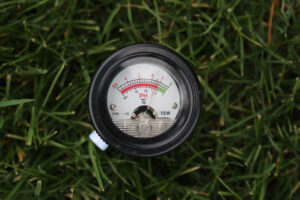
- Home test kits
- Electronic pH meters
- Professional laboratory testing
If severely low pH is suspected, a soil sample can be sent to a commercial or university lab. The results of the soil test will specify how much lime should be added in a single or multiple applications to correct the problem. In addition, any other nutrient deficiencies that may exist will be specified, and recommendations on treatment to correct these issues will be provided. Soil tests are a very accurate and useful tool in determining hard to diagnose turf issues. However, soil test results take time and are an added expense, which is why they are less practical for determining pH on every lawn.
Because much of the Northeastern United States — including New Jersey and Eastern Pennsylvania — has naturally acidic soils due to high rainfall and weathering, lime applications are a very common and important part of professional lawn care programs.
If you are in our service area and want to know more about liming your lawn or testing the pH, give our office a call at 908-281-7888. Also, you can learn more about our liming process on our website.
Frequently Asked Questions about Lime and Soil pH
Q: Will lime raise or lower pH?
A: Lime is used to raise the pH of acidic soils, making them less acidic and more suitable for plant growth.
Q: Is lime alkaline or acidic?
A: Lime is an alkaline material. It increases soil pH by neutralizing acidity.
Q: Does lime help with pH balance?
A: Yes. Lime helps balance soil pH by counteracting excess acidity and moving soil toward the optimal range for plant health.