
Moss is a plant that generates a lot of questions from our customers. Most homeowners want to know why it appears in their lawn and what can be done to get rid of it. Moss seems opportunistic and can usually be found where grass struggles to grow.
It is important to know that moss presence is usually a symptom of underlying lawn conditions rather than the cause of grass loss. Understanding the ideal conditions for moss, such as excessive moisture, soil compaction and shade, can help you develop a plan to increase favorable grass and decrease moss on your property.
Why Moss Grows in Your Lawn
Moss in your lawn is typically a reflection of underlying issues rather than a primary cause of grass death. It is an opportunistic, non-vascular plant that thrives in environmental conditions such as shade, moisture, or compacted soil. These conditions happen to be the same conditions that are difficult for favorable grass types to tolerate.
So, when your grass struggles to grow, moss can move in and fill the open spaces.
What is Moss?
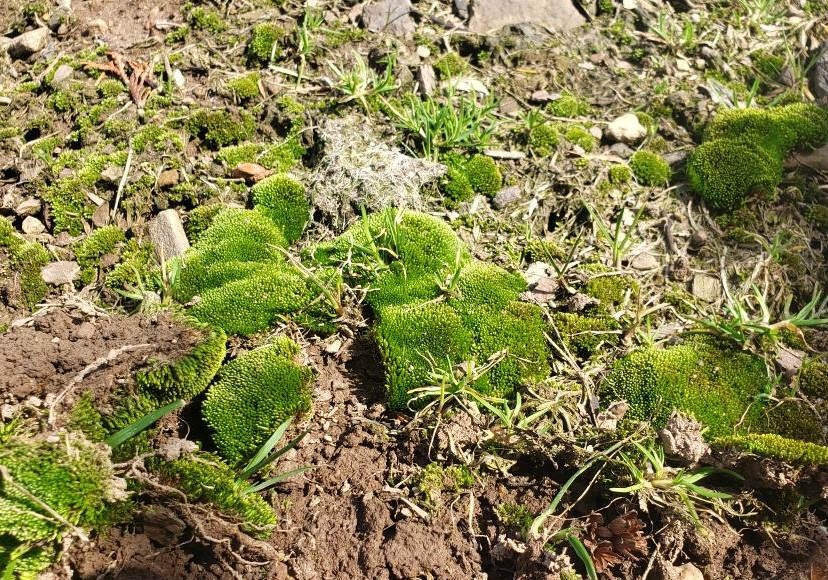
Moss is a non-flowering plant that grows low to the ground and lacks a true root system. Instead of roots, moss absorbs moisture and nutrients directly through its leaves.
It reproduces through spores and spreads easily across surfaces where grass has thinned or failed to establish. Because moss does not have deep roots, it can grow on compacted soil, rocks, and even hard surfaces where turfgrass cannot survive.
Environmental Factors Favoring Moss Growth
Several environmental conditions can create an ideal environment for moss while simultaneously making it difficult for turfgrass to grow.
Excessive Shade
Most cool-season turfgrasses, those that comprise healthy lawns in our service area, require 4–6 hours of direct sunlight per day to grow properly. Heavy shade from trees, fences, or buildings reduces sunlight reaching the soil surface. When grass cannot photosynthesize efficiently, it begins to thin or die, creating open spaces where moss can establish.
Moss tolerates low-light environments extremely well, which gives it a competitive advantage in shaded areas.
Poor Drainage and Excess Moisture
Moss thrives in damp environments and is composed of nearly 90% water itself.
Areas that remain wet for long periods, such as low spots in the lawn, clay soils, or areas that receive excessive irrigation, create ideal conditions for moss growth. Grass roots require oxygen in the soil to survive, and constantly saturated soil limits that oxygen supply, effectively drowning the grass plants
As turf declines in wet areas, moss can quickly colonize the exposed surface.
Soil Compaction
Soil compaction is a common issue in our service area throughout Central New Jersey and Eastern Pennsylvania, where soil tends to be clay-based.
Foot traffic, mowing equipment, pets, and regular lawn use can compress the soil over time. Compacted soil reduces the movement of air and water through the soil profile and restricts root growth. Because moss does not rely on deep roots, it can easily grow across the surface of compacted soil where grass struggles to establish.
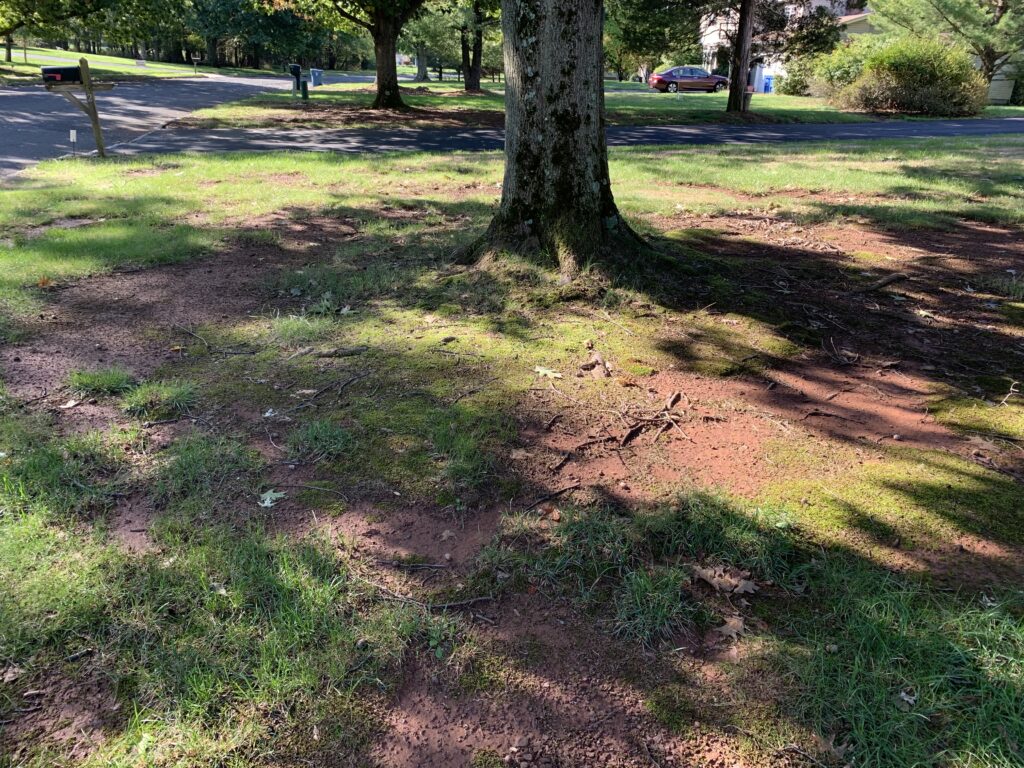
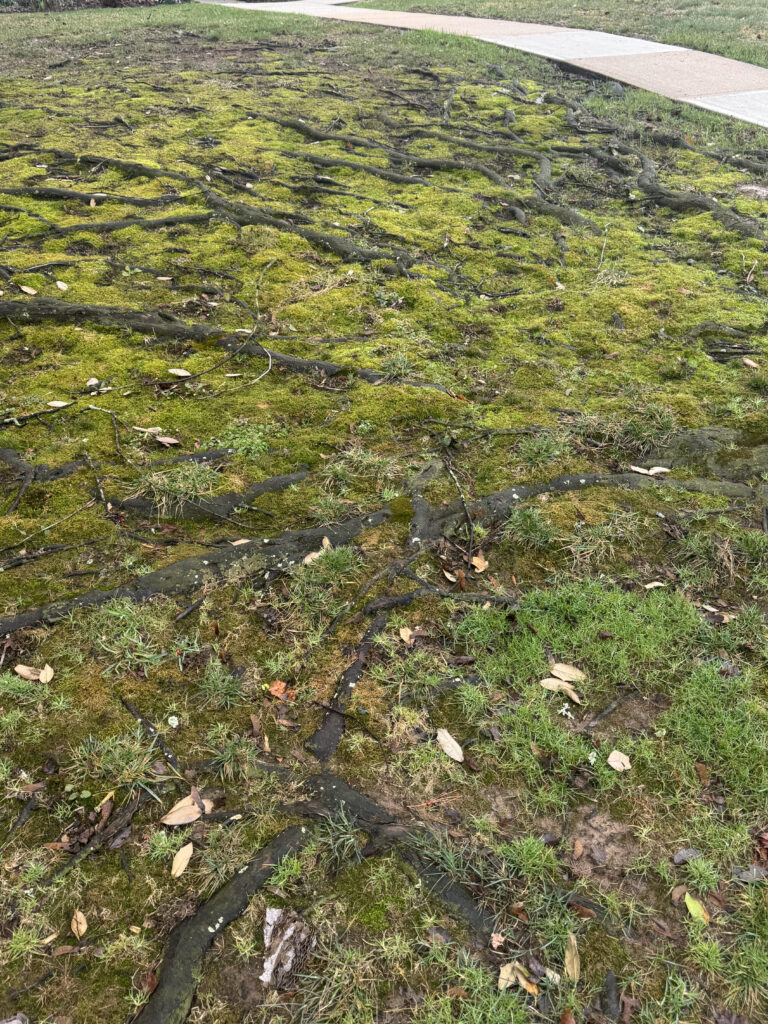
A common area we get a lot of questions about are below trees. Not only are these areas shaded, but they are also more susceptible to compaction. Because the tree roots run below the soil’s surface, the thin layer of soil above those roots will compact much easier. This combination of shade and compaction makes areas below trees ideal for moss growth.
Soil Acidity (Low pH)
Moss typically thrives in acidic soil, with an ideal pH range often cited between 5.0 and 5.5. However, moss is highly adaptable and can tolerate pH levels at a wide range of levels.
While moss prefers acidic conditions, it can still grow in soil with neutral or even slightly alkaline pH if shade and moisture are present.
For most cool-season grasses grown in our area, an ideal soil pH is between 6.3 and 6.5. Because moss presence alone does not confirm a pH issue, a soil test is the best way to determine whether lime is necessary.



Low Soil Fertility
Grass requires nutrients, like nitrogen, to maintain healthy growth and density. For this reason, season specific fertilizers are the hallmark of professional lawn care programs. As is the case in all the lawn care programs we offer.
When soil fertility is low, grass becomes weak and thin. This reduced vigor allows moss to fill in the gaps because moss requires far fewer nutrients than turfgrass to survive.
Mowing Practices and Thatch
We see cultural practices, like mowing, can also influence moss proliferation. Cutting grass too short, often referred to as scalping a lawn, weakens turf and reduces its ability to compete with other plants. In addition, excessive thatch buildup can trap moisture at the soil surface. As we have discussed above, both conditions create an environment where moss can be established more easily.
How Moss Reproduces
Moss spreads very efficiently through two primary methods.
- First, it reproduces through spores, which are dispersed by wind or water. These microscopic spores can travel long distances and establish new colonies when conditions are favorable.
- Moss can also reproduce asexually, meaning small fragments that break off can grow into new plants. This is why moss can quickly spread once it becomes established in an area.
Getting Rid of Moss
In our experience managing lawns in the NJ and PA area, we have learned that the most effective long-term solution for decreasing moss is changing the environmental conditions that allow it to thrive. Here are a few suggestions on how to do this:
Improve Sunlight
If moss appears in heavily shaded areas, increasing sunlight can help grass compete more effectively. Pruning or thinning tree canopies can allow additional light to reach the lawn surface. Alternatively, if grass continues to struggle in heavily shaded areas of your property, we might recommend you convert that area to a landscape bed.
Relieve Soil Compaction with Core Aeration
Core aeration is one of the most effective ways to reduce soil compaction. This mechanical process removes small plugs of soil approximately three to four inches deep, allowing oxygen, water, and nutrients to penetrate deeper into the soil profile. The openings created by aeration also provide space for grass roots to expand.
In areas with significant compaction, core aeration may be recommended annually. At a minimum, we recommend core aeration every other year given the soil types in our area. If you’re interested in more information on the benefits of core aeration for your property, check out our blog: The Benefits of Core Aeration: Why Your Lawn Needs to Breathe.

Improve Drainage and Watering Practices
Moss will grow in areas of your property that remain damp. This can be caused by poor drainage or improper irrigation. You may need to decrease watering frequency or duration for zones of your lawn that remain wet. Also, low lying areas that consistently hold water may require drainage improvements or soil amendments to promote better water movement.
Adjusting Soil pH for Moss Control
It is true that moss prefers acidic soil. Moss prefers the soil pH to be between 5.0-5.5. So naturally you would think that adding lime to your lawn, making it more alkaline, would be a guaranteed solution. In our 40 years of lawn care experience, we have seen that while adjusting soil pH to the ideal range, 6.3-6.5 is very beneficial, it is not the only answer to ridding your lawn of moss.
Adjusting soil pH to an ideal range will help your grass grow more vigorously. Therefore, they can compete more aggressively with moss. Unfortunately, moss is durable enough to still grow in an ideal turf pH range if the other environmental factors it favors (moisture, soil compaction and shade) are still present.
We recommend getting a pH reading on your lawn, via a soil analysis, before deciding to apply lime. For a more in-depth look at liming your lawn, check out our blog: Soil pH and Lime: How Lime Affects Your Soil.
Physical Removal and Moss Control Products
If you want to remove moss quickly, it can be raked out of the lawn manually.
Products containing iron sulfate (ferrous sulfate) are also commonly used to kill moss. These products are available at most home improvement stores and can be effective for short-term control. However, if the environmental conditions remain unchanged, moss will likely return.
It is important to note that weed controls like crabgrass pre-emergent and broadleaf weed control applications will have no impact on moss. They are different plant types entirely.
Conclusion
The most effective way to reduce moss in your lawn is to improve the growing conditions for ideal grass types. Addressing issues such as shade, soil compaction, drainage, and soil fertility will help grass grow thicker and stronger, allowing it to naturally outcompete moss.
In some areas where grass consistently struggles — such as dense shade — moss can even function as a low-maintenance ground cover. However, if your goal is healthy turf, correcting the environmental conditions is the key to long-term success.
If you have questions about moss in your lawn or would like help evaluating your property, contact the team at Fairway Green for professional guidance or request a free estimate.
Frequently Asked Questions About Moss In Your Lawn:
Q: What does moss in a lawn indicate?
A: Moss usually indicates environmental stress such as shade, poor drainage, soil compaction, or nutrient deficiencies that prevent grass from growing successfully.
Q: Is moss acidic or alkaline?
A: Moss prefers acidic soil, typically between pH 5.0 and 5.5, but it can grow in neutral or even slightly alkaline soils if other favorable conditions such as moisture, compaction, and shade are present.
Q: Does increasing soil pH get rid of moss?
A: Raising soil pH to around 6.3-6.5 can help grass compete with moss, but adjusting pH alone will not eliminate moss unless other environmental issues are also addressed.
Q: Does moss need roots to grow?
A: No. Moss is a non-vascular plant that lacks true roots. Instead, it absorbs water and nutrients directly through its leaves.
Q: What kills moss but not grass naturally?
A: Iron sulfate (ferrous sulfate) is commonly used to kill moss without damaging turfgrass. However, this is typically a temporary solution unless underlying environmental factors are corrected.